Discography

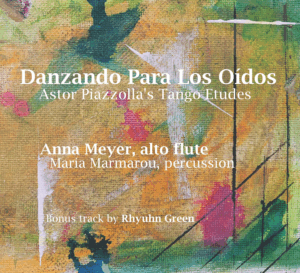 Danzando Para Los Oídos
Astor Piazzolla’s Tango Etudes for Alto Flute and Improvised Percussion
Released in March of 2026, Danzando Para Los Oídos is a new exploration of Piazzolla’s six Tango Etudes for solo flute. Recorded on alto flute with improvised percussion, this album will challenge the way we have historically considered these gems of the flute repertoire. The rich sonorities of the alto flute lend themselves to the dark and sensuous affect that the Etudes invoke. I am joined on this album by jazz drummer Maria Marmarou, whose extensive experience in the jazz idiom made her the perfect choice to improvise a percussion part. Her creative and thoughtful approach to her instruments and how they pair with the Etudes is evident in the variety of sonic color she is able to produce. Each Etude has its own character, whether that’s a rumbling distant drum (Etude #2), a sassy cajon (Etude #3), or a mix of several instruments and timbres (Etude #5), Maria’s improvisations bring a fresh perspective to the Etudes.
The title track is a bonus track written by young composer and Philadelphia native Rhyuhn Green as a companion piece for the Tango Etudes. I met Rhyuhn through my work managing the Marian Anderson Young Artist Program and have been impressed with watching him grow as a composer and musician. I commissioned him to write a piece for solo alto flute that would pair nicely with the six Etudes, and his Danzando does not disappoint. The piece celebrates the drive and accented punctuation of Piazzolla’s faster Tango Etudes, combined with Green’s signature rhythmic complexities and harmonic voice.
The album is recorded and produced by BCM&D Records, and is available on all of your favorite digital platforms. Cover art by Z Rossi.
Praise for Danzando
The Flutist Quarterly Review – BJ Nicoletti
“This album will endure as one of the “go to” recordings….Meyer’s range of expression, colors, improvisations, and twists [is]—sassy and jazzy. Meyer’s [interpretation] gives each etude center stage drama, deep and moving moods, and a myriad of colors. At no point does this combination feel out of balance, disjunct, or contrived—each one somehow feels larger. There is an unexpected symbiosis, as if always meant to be this way.”
 Fantasmagoria
The Fantasmagoria project stems out of my doctoral research, the first step of which was the commissioning of five new pieces for flute and organ. My research focuses on the existing repertoire, its strengths and weaknesses, and the undeniable fact that not a lot of concert music exists for this combination of instruments. I have played plenty of hymn tune arrangements with organ chordal accompaniment. The problem is that neither flutist nor organist seeks out these arrangements for the concert or worship setting. If I’m honest, we don’t see a lot of organists seeking out flutists in general. Organists like brass players! I had to ask myself the difficult question of why. Why don’t organists seek out flutists? And I believe the answer has to do with the perceived tendencies of both instruments. The organ is powerful, mighty, and according to Mozart, the “king of instruments.” The flute is gentle and timid and…soft. This project – the commissioning and the recording – sets out to prove those stereotypes wrong. My duo partner/husband and I have found that both instruments can complement one another, given a compositional style that plays to the strengths of each instrument. For example, when performing John Weaver’s Rhapsody, the organist can use full organ in several places because the flute is playing in the upper register. Similarly, the end of Frank Martin’s iconic Sonata da Chiesa treats the flute as another pipe on the organ, and it is the flutist’s job to melt into whatever registrational color the organist chooses.
After over 15 years of performing together, my husband and I began to tire of recycling the same few pieces. Audiences were taken by the handful of well-written works, but we were limited in the frequency of our performances, due simply to not wanting to replicate the same program for the same audience. Then one evening, in a fortuitously-timed conversation at a party, this question was posed to me: What if you could just commission a full concert’s worth of music for flute and organ? Fantasmagoria was born.
I was then faced with choosing composers, who I knew would be equally at home with writing for the flute and the organ. Interestingly, all these composers are well-versed in the choral music tradition, and therefore, perfect candidates for composing for the organ and the voice-like flute. Each composer brings his unique voice, whether jazzy, liturgical, cunning, vocal, or exuberant, and these pieces celebrate the strengths of the combination of forces in the flute and organ. The composers bring out the singing qualities of the flute, the sonorous capabilities of the organ, the agility of the flutist and, of course the dexterity of the organist to provide five well-crafted concert pieces.
All five new pieces plus the Lydian Suite by Erik are recorded and produced by David Pasbrig. The album is available on itunes, Amazon music, and all of your favorite digital platforms. Digital artwork and layout by Jacob Wessler.
Questions about any of these pieces or about flute and organ music? Just contact me using this form.
Pieces in the Fantasmagoria Project
Epistle Sonata by Carson Cooman
Passacaglia for Flute and Organ by Parker Kitterman
Fantasmagoria by Erik Meyer
With Pipes of Tin and Wood by Till Meyn
A Child’s Afternoon by Kile Smith
Program Notes for the Fantasmagoria collection can be found here.
Praise for Fantasmagoria
David Cramer – Former Associate Principal Flutist of the Philadelphia Orchestra
[The] recital was a very unusual occasion. Anna was able to commission five composers to write concert pieces for flute and organ, which is a combination that is not known for its huge repertoire. I myself know very little repertoire for this combination, especially original repertoire. I have often played transcriptions with organ over the years, and always in a worship setting as part of the service. So this concert was, I feel, quite important. All five works were very strong concert pieces. There was a wide range of styles and expression, although they were all of similar length. They gave both performers a chance to display their musicality and virtuosity. The balance was hardly ever a problem, which is no small feat, considering the volume possibility and range of the organ compared to that of the flute….Any of [the pieces] would certainly be a very strong part of a concert recital. Many times, chamber concerts are played in churches, and I would think that these pieces all could be incorporated well into a concert with a variety of groups and genres. This would be a very interesting repertoire for the audience. And of course, for an organist giving a recital, any of these pieces would be [a] wonderful way to vary a program. I can’t commend Anna and her husband Erik enough for providing flutists and organists with this impressive new repertoire!
Alan Morrison – Renowned concert soloist and Curtis Institute of Music Organ Faculty
There is a desperate need for more organ/flute rep. We have our fair share of brass/organ etc… and often times the flute rep, small as it is, is always sweet and lyrical. Like cello/organ. Anything for the original combination (not transcriptions) are always “Prière, Cantabile, Adagio”…so this compilation of new works will certainly make a strong impact.
Donald Sutherland – International soloist and former professor of organ at Peabody Institute
Thank you, Anna for this amazing addition to the concert repertoire, and for the many new opportunities for collaborative performances it offers. From my perspective, there seems to be no lack of safe liturgical music for flute and organ, but very little in the way of classical concert repertoire of any great depth or challenge. As a concert organist who almost always included another instrument or voice to my recitals, this fills an exciting need. This new collection will delight both audiences and performers alike. The writing is idiomatic for both instruments, and worthy of the effort to bring it off the printed page. It is a major addition to the repertoire, and for that, I am grateful for your role in making this possible.